


The FDE Advantage: Why Your Next Engineering Hire Should Be “Forward Deployed”
In the world of enterprise software, there’s a recurring tragedy: a brilliant product is built in a vacuum, only to collide with the messy reality of a customer’s legacy infrastructure, siloed data, and complex workflows. The result? A “successful” sale that never actually delivers value.
At Tesark, we’ve seen that the gap between shipping code and solving problems is where most digital transformations fail. To bridge this, a new role has moved from the fringes of defense tech (pioneered by Palantir) into the mainstream of high-growth AI and SaaS companies: the Forward Deployed Engineer (FDE).
If you’re scaling a technical product or leading a digital overhaul, the FDE might be the most strategic hire you make this year. Here’s why.
What Exactly is a Forward Deployed Engineer?
Think of an FDE as a “Technical Special Forces” unit. While your core software engineers are the architects building the platform, the FDE is the one on the ground, embedded with the customer.
They aren’t just consultants who give advice and leave a slide deck behind. They are builders. An FDE writes production-grade code, handles complex integrations, and navigates the “last mile” of deployment where off-the-shelf solutions usually break.
“The core of the FDE model is that you send empowered engineers directly to spend intense time embedded with customers, with the express purpose of learning the problem and solution space, so they can discover a solution that will achieve the necessary outcome.” — Marty Cagan, SVPG [1]
The Bridge Between Product and Reality
Traditional software engineering is often “I-shaped”—deeply specialized in a specific stack. Forward Deployed Engineering is “T-shaped”—it requires technical depth plus the broad ability to communicate with VPs, de-escalate technical crises, and translate vague business pains into clean technical requirements.
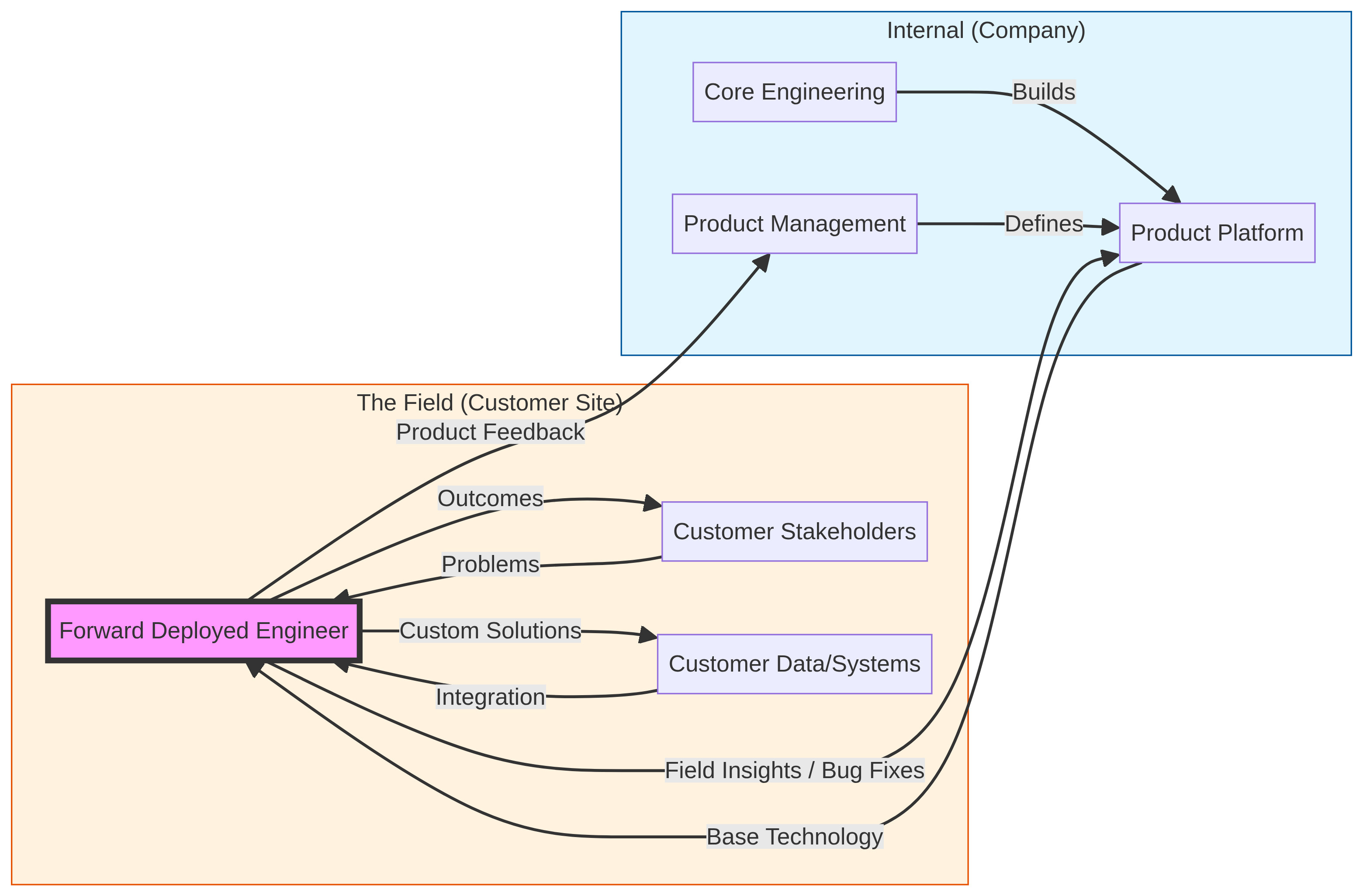
As shown above, the FDE sits at the critical intersection of your internal product development and the customer’s real-world environment. They act as a high-fidelity feedback loop, ensuring that what you build internally is actually what the market needs.
FDE vs. Traditional Software Engineer: A Quick Comparison
| Dimension | Forward Deployed Engineer (FDE) | Software Engineer (SWE) |
|---|---|---|
| Primary Goal | Customer outcome & technical success. | Feature development & platform stability. |
| Context | The customer’s messy environment. | The company’s controlled codebase. |
| Ownership | End-to-end (Discovery to Deployment). | Component or service-level ownership. |
| Feedback Loop | Direct conversation with users/stakeholders. | Analytics, PMs, and internal reviews. |
| Travel/Embedding | High (often on-site or deeply integrated). | Low to none. |
Why Companies are Racing to Hire FDEs
The demand for FDEs has exploded—some reports show a 10-fold increase in job postings recently [2]. This isn’t just a trend; it’s a response to the increasing complexity of “Production-Grade” technology.
1. Faster Time-to-Value
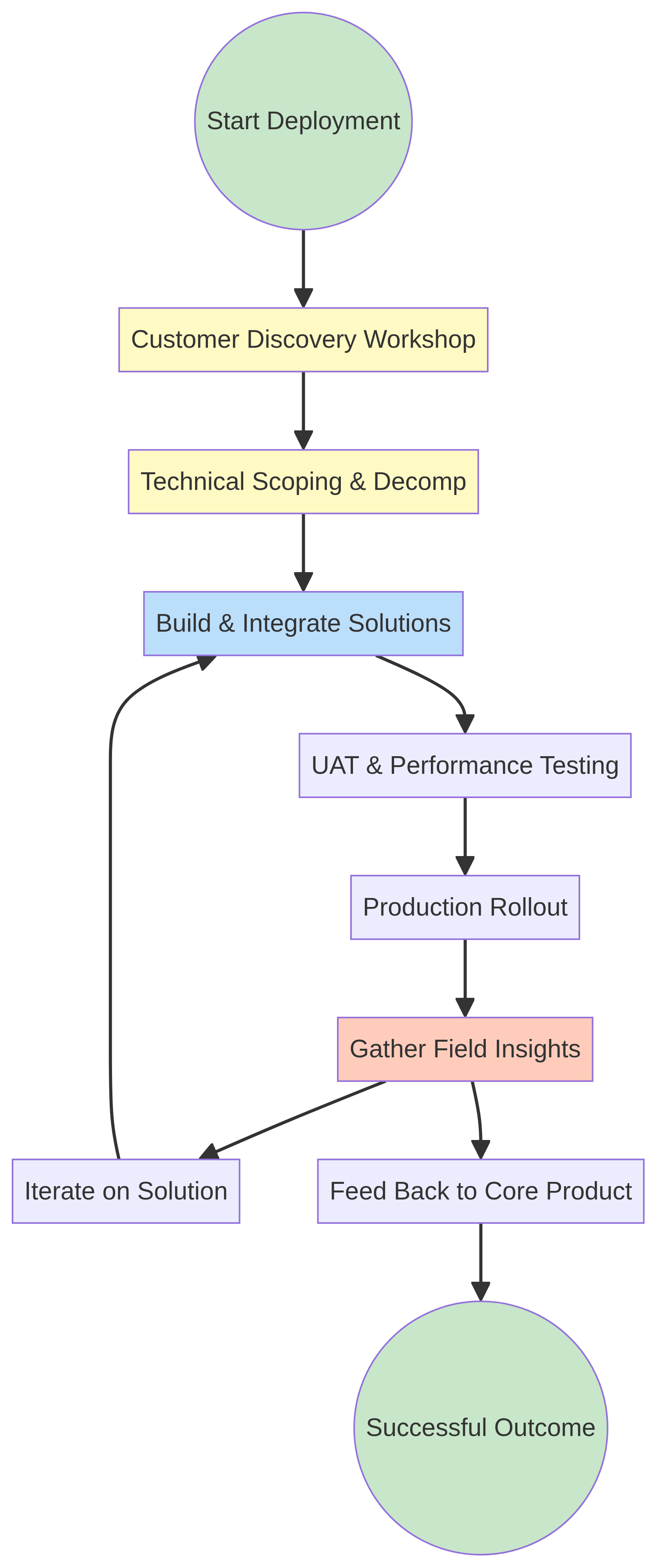
An FDE doesn’t wait for a perfect spec. They run discovery workshops, build prototypes on-site, and iterate until the solution works. This cuts down the “dead time” between a signed contract and a live system.
2. The Ultimate Product Feedback Loop
When an engineer watches a customer struggle with an API or a dashboard in real-time, they don’t just fix it for that customer—they bring that insight back to the core team. This prevents “ivory tower” development and keeps your roadmap grounded in reality.
3. Managing “Last Mile” Complexity
Enterprise deployments are rarely “plug and play.” They involve SSO, VPCs, IAM policies, and legacy databases. FDEs thrive in this ambiguity, handling the heavy lifting of integration so your core team can stay focused on the next big feature.
The FDE Workflow: From Discovery to Outcome
Hiring an FDE changes how you deliver software. It moves you from a “vendor” relationship to a “partner” relationship.
Is an FDE Right for Your Team?
You should consider hiring an FDE if:
- Your product is highly technical: Think AI, data infrastructure, or cybersecurity.
- You sell to the Enterprise: Where every deployment requires custom integration.
- You have a “Last Mile” problem: Your sales are closing, but deployments are stalling.
Final Thoughts
The rise of the Forward Deployed Engineer marks a shift in how we think about engineering. It’s no longer enough to build great software; we have to ensure it works where it matters most. For companies looking to scale operations and deliver on the promise of AI and digital transformation, the FDE is the missing piece of the puzzle.
References
[1] Marty Cagan, “Forward Deployed Engineers,” SVPG [2] GoFractional, “What Is a Forward Deployed Engineer?” [3] TryExponent, “Forward Deployed Engineer vs. Software Engineer” [4] Palantir Blog, “Dev versus Delta: Demystifying engineering roles”