

Recommendation systems have become remarkably good at learning what we may want to consume next. They observe behaviour, detect patterns, and quietly shape what appears in front of us. But what happens when the same idea moves beyond content? Can action systems learn what we are trying to achieve before we navigate through software to do it? That possibility points toward invisible UX — but it is much harder than it first appears.
Software today still expects users to understand how the product is organised before they can get anything done. We open an app, find the right section, locate a feature, understand the workflow, enter the required information, and submit the action. Even when the goal is simple, the user is responsible for translating intent into the product’s structure. The interface becomes the tax we pay to act.
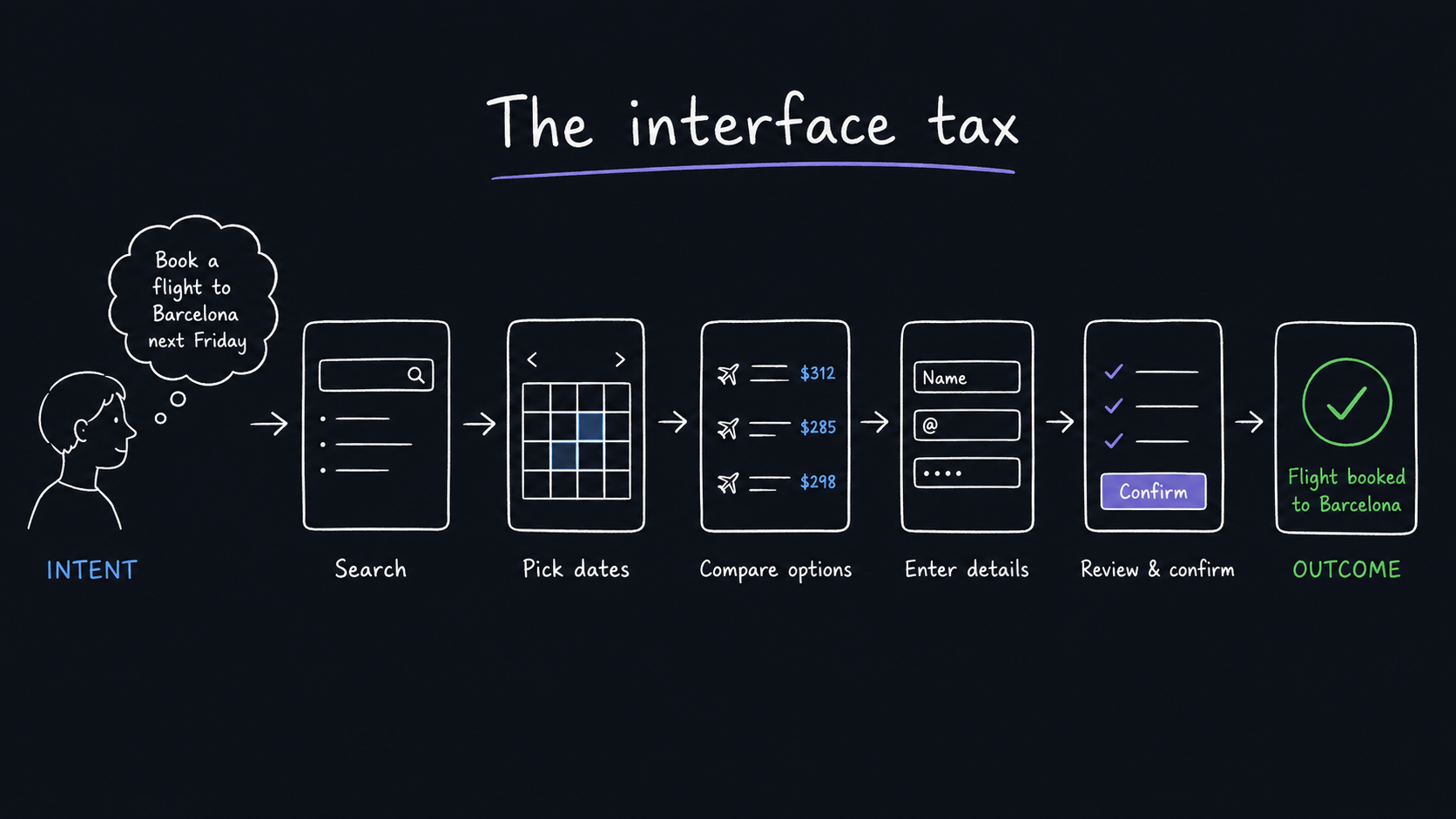
one intent, six screens of navigation, one outcome. every step in between is the tax.
AI begins to change that relationship. Instead of asking users to navigate through software, the system can start with the outcome they want and work backwards. The user expresses the intent, while the software identifies the path, gathers the context, and prepares the action. Invisible UX is not about removing screens or devices. It is about removing the effort between wanting something done and actually doing it.
Recommendation systems offer the clearest precedent. Instagram, TikTok, and YouTube learned what people might want to watch without asking them to define their preferences. Every pause, skip, replay, and interaction became a signal. Over time, consumption became almost effortless. The natural next question is whether software can learn context, behaviour, and likely intent in the same way — then prepare an action before the user manually navigates towards it.
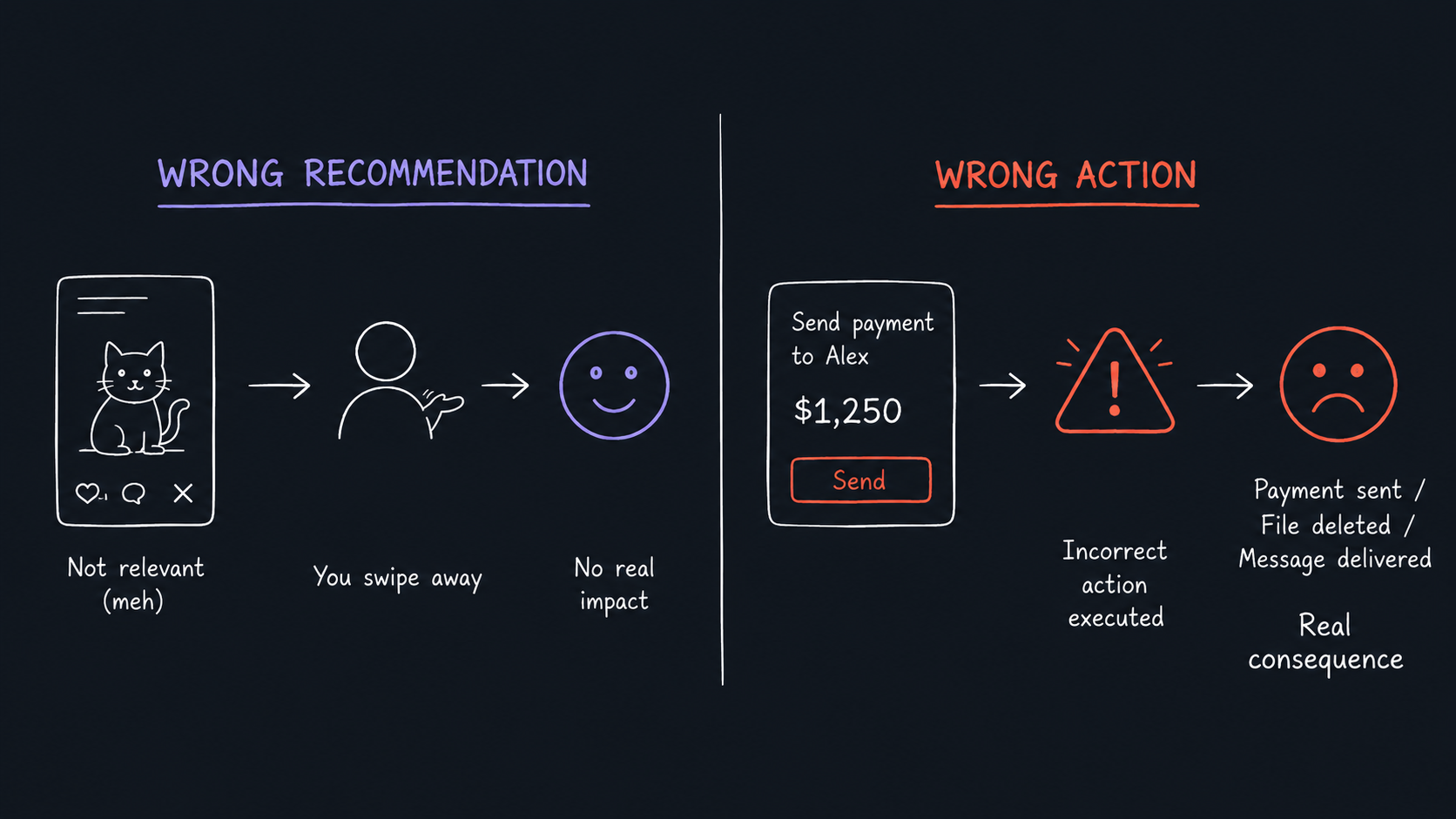
same shape, different ending. one flow ends with you deciding. the other ends with the system acting.
The idea also fits how people already behave. Repeated actions gradually move into the background, until we stop thinking about each step and focus only on the result. We do not consciously plan every movement when unlocking a phone, replying to a familiar message, or following a daily routine. Invisible UX extends that pattern into software by allowing the system to handle steps the user no longer needs to think about.
But recommendations and actions are not equally forgiving. A bad recommendation costs a few seconds of scrolling. A bad action can send money, delete a file, book the wrong meeting, or message the wrong person. Recommendation systems learned through billions of low-cost mistakes. Action systems might not get the same freedom to fail.
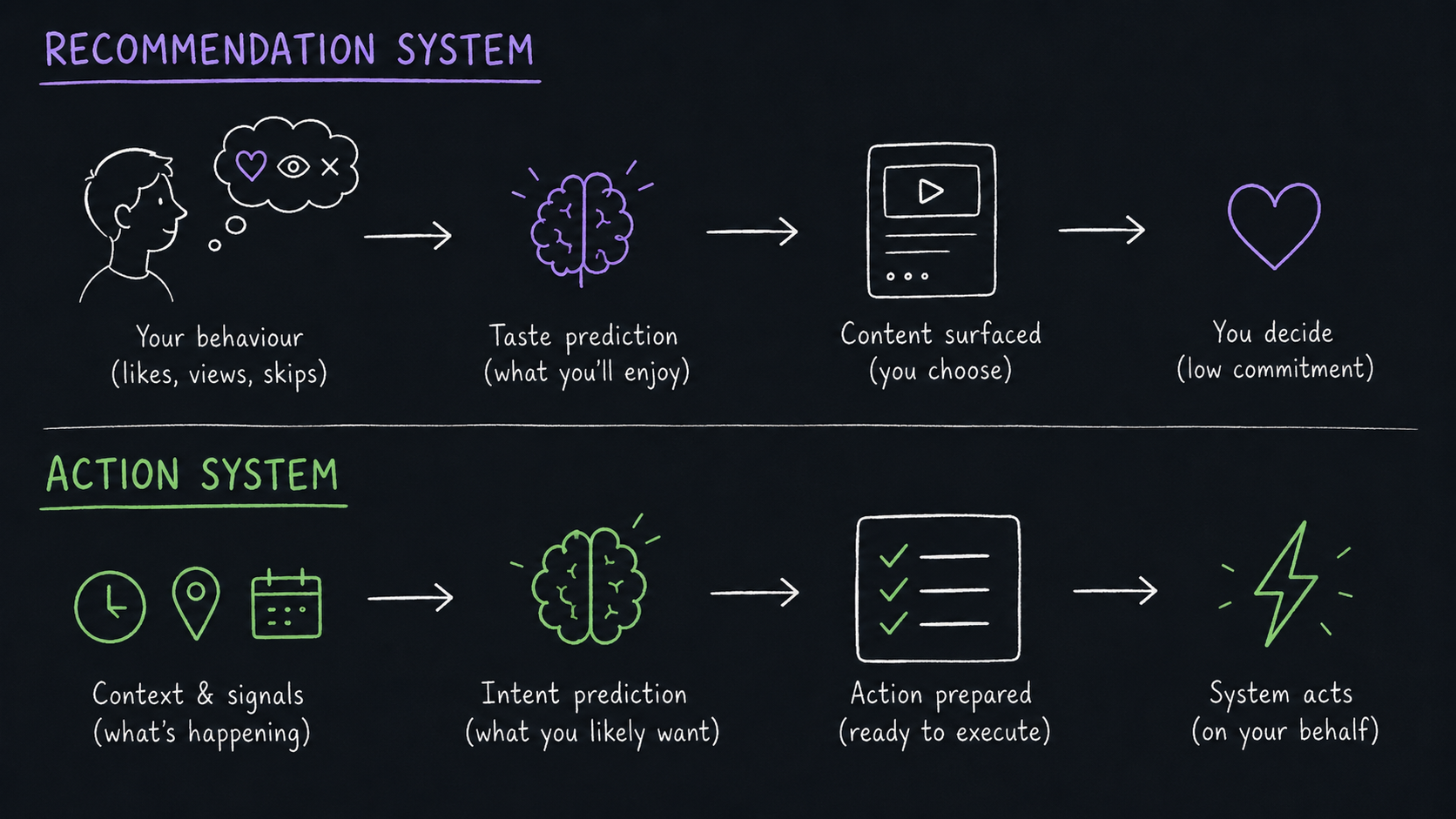
a wrong recommendation is a shrug. a wrong action is a consequence.
That difference changes the entire design problem. An action system cannot simply observe mistakes and improve after the fact. It must understand uncertainty before acting, recognise when the consequences are serious, and know when to pause for clarification or confirmation. The challenge is not only predicting intent. It is knowing when that prediction is trustworthy enough to become an action.
Friction is not the enemy. Misplaced friction is.
There is another, quieter risk. Friction does more than slow us down; it can also create a moment of attention. When too much of the interaction disappears, users may approve an action without fully processing what the system understood or what it is about to do. The problem is not whether friction should exist, but where it should appear.
The experience could remain invisible by default and become visible only at moments of consequence. Routine, reversible actions may need almost no interruption. Uncertain or high-impact actions may need a clear explanation, a warning, or an explicit confirmation. The real design challenge is deciding when the interface should disappear — and when it must return.
Earning the right to act
That leaves an open question: how does a system earn the right to act without asking every time? Trust may not transfer cleanly across action types. A user may be comfortable letting software organise files or draft messages, yet hesitate when the same system wants to send money, change a booking, or contact someone on their behalf.
We can see the destination: software becoming an extension of intent. What remains unclear is the road from explicit commands to systems trusted enough to act on our behalf.
The open question
What is the first action category where users will allow the interface to disappear entirely?